
 Facebook
 X
X LinkedIn
 Forward
Houston Citywide Conference: Mechanical Ventilation Masterclass 2026 - March 17, 2026
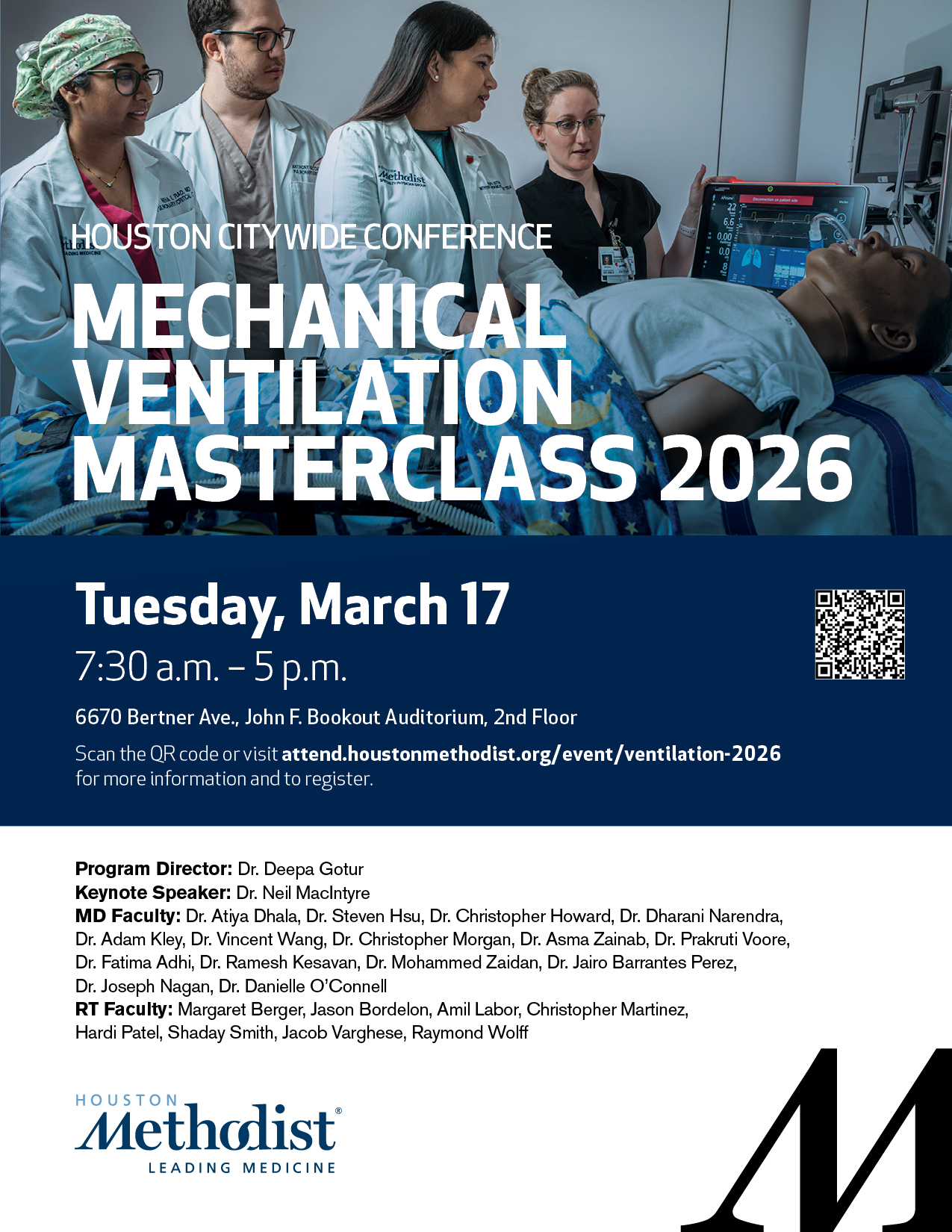
Discover the art and science of mechanical ventilation in this immersive, hands-on course. You’ll explore the fundamentals of positive pressure breathing and master advanced ventilator management techniques to ensure patient safety and optimize outcomes. Through interactive sessions and simulation-based training, you’ll learn to interpret waveforms, configure specialized modes, troubleshoot alarms, and fine-tune settings to address patient-ventilator dyssynchrony. Gain expertise in analyzing pressure-volume loops, optimizing PEEP, monitoring transpulmonary pressure, and applying lung-protective strategies. Plus, develop practical skills in ventilator mechanics and diaphragmatic ultrasound to assess readiness for weaning. Join us at Bookout Auditorium and MITIE Lab for a transformative learning experience designed for critical care excellence.
COURSE DIRECTOR
Deepa Gotur, MD, FCCP, FCCM
Faculty
Atiya Dhala, MD, FACP, FCCM
Asma Zainab, MD
Steven Hsu, MD
Dharani Narendra, MD
Christopher Howard, MD, FCCP
FEES
| REGISTRATION TYPE | FEE |
|---|---|
| Resident / Fellow / Student | Complimentary |
Learning Objectives
At the conclusion of this activity, the participant should be able to:
- Explore the fundamental principles underlying positive pressure mechanical breaths.
- Gain proficiency in administering safe mechanical ventilation by interpreting ventilator waveforms effectively.
- Develop the skills to monitor and troubleshoot ventilator alarms to ensure patient safety.
- Learn to configure advanced ventilator modes tailored to specific clinical indications.
- Acquire the ability to make precise ventilator adjustments to address patient-ventilator dyssynchrony and optimize ventilation outcomes.
- Gain comprehensive knowledge and practical skills in analyzing pressure-volume loops, assessing compliance and stress index, optimizing PEEP levels, monitoring transpulmonary pressure, understanding mechanical power and driving pressure, implementing lung-protective ventilation strategies, and applying ultra-protective ventilation techniques.
- Learn to perform Ventilator mechanics and Diaphragmatic ultrasound to assess readiness of weaning from the ventilator
Course summary
- 8.75 AMA PRA Category 1 Credit™
Houston Methodist is accredited by the Accreditation Council for Continuing Medical Education to provide continuing medical education for physicians.
Houston Methodist designates this Live activity for a maximum of 8.75 AMA PRA Category 1 Credit™. Physicians should claim only the credit commensurate with the extent of their participation in the activity.
- 8.75 Attendance
- 8.75 Respiratory TherapistsThis program has been approved for a maximum of 8.75 contact hours Continuing Respiratory Care Education (CRCE) credit by the American Association for Respiratory Care, 9425 N. MacArthur Blvd. Suite 100 Irving TX 75063
Houston Citywide Conference: Mechanical Ventilation Masterclass 2026
Date: March 17th, 2026
Course Director: Dr. Deepa Bangalore Gotur
Keynote Faculty: Dr. Neil McIntyre
Faculty: Dr. Atiya Dhala, Dr. Steven Hsu, Dr. Christopher Howard, Dr. Dharani Narendra, Dr. Adam Kley, Dr. Christopher Morgan, Dr. Asma Zainab, Dr. Prakruti Voore, Dr. Muhammad Hayat, Dr. Fatima Adhi, Dr. Ramesh Kesavan, Dr. Karthik Vadamalai, Dr. Jairo Barrantes Perez, Dr. Joseph Nagan, Dr. Danielle O’Connell, Dr. Khalid Mohamed Ahmed, Dr. Mahnoor Mir
RT faculty: Jason Bordelon, Margaret Berger, Raymond Wolff, Christopher Martinez, Hardi Patel, Amielle Labor, Jacob Varghese, Ali Afroz
Course Objectives
- Explore the fundamental principles underlying positive pressure mechanical breaths.
- Gain proficiency in administering safe mechanical ventilation by interpreting ventilator waveforms effectively.
- Develop the skills to monitor and troubleshoot ventilator alarms to ensure patient safety.
- Learn to configure advanced ventilator modes tailored to specific clinical indications.
- Acquire the ability to make precise ventilator adjustments to address patient-ventilator dyssynchrony and optimize ventilation outcomes.
- Gain comprehensive knowledge and practical skills in analyzing pressure-volume loops, assessing compliance and stress index, optimizing PEEP levels, monitoring transpulmonary pressure, understanding mechanical power and driving pressure, implementing lung-protective ventilation strategies, and applying ultra-protective ventilation techniques.
- Learn to perform Ventilator mechanics and Diaphragmatic ultrasound to assess readiness of weaning from the ventilator
Location: Bookout Auditorium and MITIE Lab HMRI Floor 5
Registration and breakfast: 7:00 am
Introduction to the course and pre-test: 7:15 am to 7:30 am
7:30 am to 8:30 am – All trainees will be in Primary Station Basics.
8:30 am to 10:30 am – sessions
8:30 am to 8:45 am – Advanced Modes: Dr. Asma Zainab
8:45 am to 9:00 am – Pressure and EIT: Dr. Atiya Dhala
9:00 am to 9:30 am- Dyssnchrony : Dr. Steven Hsu
9:30 am to 9:45 am – Ventilator Weaning strategies: Dr. Dharani Narendra
9:45 am to 10:00 am– Diaphragmatic ultrasound: Dr. Fatima Adhi
10:00am to 10:15 am – Closed Loop Ventilation: Dr. Christopher Howard
10:15 am to 10:30 am - Break
Location: MITIE, Research Institute, 5th Floor
10:30 am to 11:15 am – Rotation to stations based on assigned groups
11:15 pm to 12:00 am – Rotation to stations based on assigned groups
12:00 pm to 12:30 pm – Lunch break
12:30 pm to 1:15 pm - Rotation to stations based on assigned groups.
1:15 pm to 2:00 pm - Rotation to stations based on assigned groups.
2:00 pm to 2:15 pm – break
2:15 pm to 3:00 pm – Rotation to stations based on assigned groups
3:00 pm to 3:45 pm – Rotation to stations based on assigned groups
3:45 pm to 4:30 pm - Rotation to stations based on assigned groups
4:30 pm to 5:15 pm - Live EIT PEEP titration
5:15 pm to 5:30 pm - Closing remarks and post-test
Duration: 1.5 hours in Primary station and 45 min per station for 1,2,3,4,5,6,7
Primary Station: Basics (Bookout Auditorium) | Station 1: Dysynchrony (Sim room)
|
Basics of safe Mechanical ventilation Simulation with Michigan lung
Faculty: Dr. Neil McIntyre ([email protected]) Margaret Berger ([email protected])
Requirements: Large conference room, Vent projection to screen, Michigan lung, mechanical ventilator, AV
|
Patient-ventilator dysynchrony Simulation with Sim Man
Faculty: Dr. Steven Hsu ([email protected]) /Dr. Neil McIntyre ([email protected])/ Dr. Christopher Morgan ([email protected] )/ Dr. Muhammad Hayat ([email protected]) Christopher Martinez RT ([email protected]) Ingmar / Laerdal educators ([email protected], [email protected] ) Requirements: ASL 5000, Sim man, Mechanical ventilator – Hamilton C6/G5 |
Station 2: Pressure and Power (OR)
| Station 3: Modes (OR)
|
Airway Pressures and Compliance Simulation with live porcine model
Faculty Dr. Atiya Dhala ([email protected]) / Dr. Saadia Faiz ([email protected] )/ Dr. Jairo Barrantes Perez ([email protected] )/ Dr. Syed Ghazi Rizvi ([email protected] )/ Dr. Bilal Zafar ([email protected]) RT faculty: Raymond Wolff RT ([email protected]) Timpel educators: Christie Rose ([email protected]), Bianca Oliveira ([email protected]) Requirements: Pig with lung wash out – ARDS model, C 6 Hamilton mechanical ventilator, esophageal ballon, end tidal Co2 sensor, Screen to project ppt, EIT (provided by Timpel)
| Advanced Modes of mechanical ventilation Simulation with sim man model
Faculty Dr. Asma Zainab ([email protected]) / Dr. Prakruti Voore ([email protected]) Dr. Khalid Mohamed Ahmed ([email protected]) RT Faculty: Hardy Patel RT Ingmar/Laerdal educators ([email protected]) Hamilton educator: Tim Cahill ([email protected])
Requirements: ASL 5000, Sim man, Mechanical ventilator – Hamilton C6/G5 |
Station 4: Ventilator weaning (Sim Room) | Station 5: Diaphragmatic Ultrasound (Classroom)
|
Managing ventilator weaning based on current guidelines Simulation on Michigan lung
Faculty: Dr. Dharani Narendra ([email protected])/ Dr. Adam Kley ([email protected]) RT Faculty: Shaday Smith RT ([email protected]) Amil Labor RT Requirements: Michigan lung, G5 ventilator | Perform diaphragmatic ultrasound to assess readiness for ventilator weaning
Faculty: Dr. Fatima Adhi ([email protected]) / Dr. Muhammed Zaidan ([email protected]) Mindray contact ([email protected]) GE contact GE Venue model ([email protected]) Requirements: Specialized patient, Ultrasound – GE venue or Mindray |
Station 6: Closed-Loop Ventilation (Classroom) | Station 7: Esophageal Balloon Placement (Partial task room) |
Understand the Physiological Principles of Close Loop ventilation, setup and initiation of the mode, and trouble shoot common problems Set up and initiate CLP on a ventilator for a simulated patient. Interpret waveforms to assess patient-ventilator interaction. Adjust ventilator settings to optimize ventilation based on patient needs. Faculty: Dr. Chris Howard ([email protected])/ Ramesh Kesavan ([email protected])/ Dr. Karthik Vadamalai ([email protected]) RT faculty: Afroz Ali ([email protected]) Getinge representative Mr. Marty Partida ([email protected] Margaret Berger ([email protected]) Requirements: Hamilton C 6 ventilator Michigan Test lung | Understand concepts, physiology, indication and waveform analysis using esophageal balloon for measuring transpulmonary pressure on a simulator
Faculty: Dr. Joseph Nagan ([email protected] )/ Dr. Danielle O’Connell ([email protected] ) RT faculty: Jacob Varghese Requirements: Esophageal catheter, Simulator |
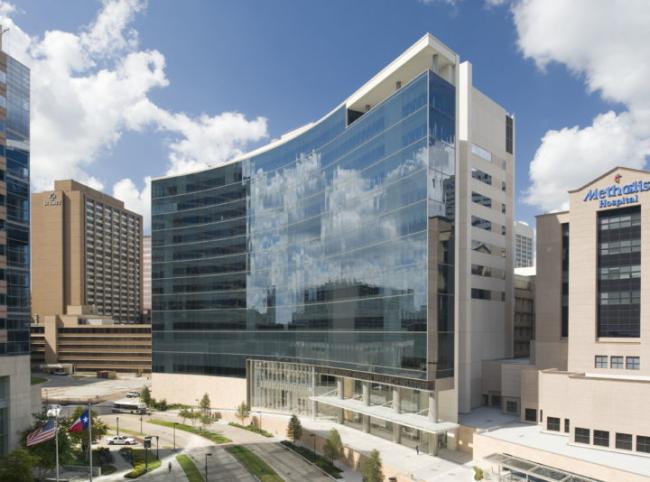
In-person attendance will be held in the Houston Methodist Research Institute, 6670 Bertner Avenue, Houston, Texas 77030.
COURSE DIRECTORS | |||
Associate Professor of Clinical Medicine Weill Cornell Medical College Program Director, Pulmonary Diseases and Critical Care Medicine Fellowship Houston Methodist Hospital Adjunct Associate Professor of Clinical Medicine Texas A&M University
Dr. Neil McIntyre
Dr. Atiya Dhala, Dr. Steven Hsu, Dr. Christopher Howard, Dr. Dharani Narendra, Dr. Adam Kley, Dr. Vincent Wang, Dr. Christopher Morgan, Dr. Asma Zainab, Dr. Prakruti Voore, Dr. Fatima Adhi, Dr. Ramesh Kesavan, Dr. Mohammed Zaidan, Dr. Jairo Barrantes Perez, Dr. Joseph Nagan, Dr. Danielle O’Connell, Dr. Muhammad Hayat
Jason Bordelon, Margaret Berger, Raymond Wolff, Christopher Martinez, Hardi Patel, Shaday Smith, Amil Labor, Jacob Varghese |
Available Credit
- 8.75 AMA PRA Category 1 Credit™
Houston Methodist is accredited by the Accreditation Council for Continuing Medical Education to provide continuing medical education for physicians.
Houston Methodist designates this Live activity for a maximum of 8.75 AMA PRA Category 1 Credit™. Physicians should claim only the credit commensurate with the extent of their participation in the activity.
- 8.75 Attendance
- 8.75 Respiratory TherapistsThis program has been approved for a maximum of 8.75 contact hours Continuing Respiratory Care Education (CRCE) credit by the American Association for Respiratory Care, 9425 N. MacArthur Blvd. Suite 100 Irving TX 75063
Interested in exhibiting? Contact us for more information.
Exhibitors
We gratefully acknowledge the following companies for participating as exhibitors for this activity:
Fisher & Paykel Healthcare
Hamilton
Innoviva
Nihon Kohden
REGISTRATION INSTRUCTIONS
- STEP 1 - Choose the activity format you would like to attend (In-Person or Virtual) by selecting the checkbox next to the activity and clicking the "Enroll" button.
- STEP 2 - Once enrolled, click the link of the activity format for which you enrolled (the Status should say "In progress") and then click the "Take Course" button to begin the activity.
FEES
| REGISTRATION TYPE | FEE |
|---|---|
| Resident / Fellow / Student | Complimentary |
* In compliance with HM’s policy on Physician Non-Monetary Compensation regarding “Stark Law,” private physicians who reside and/or practice medicine within the Greater Houston Area are required to pay the full Fair Market Value registration fee.